
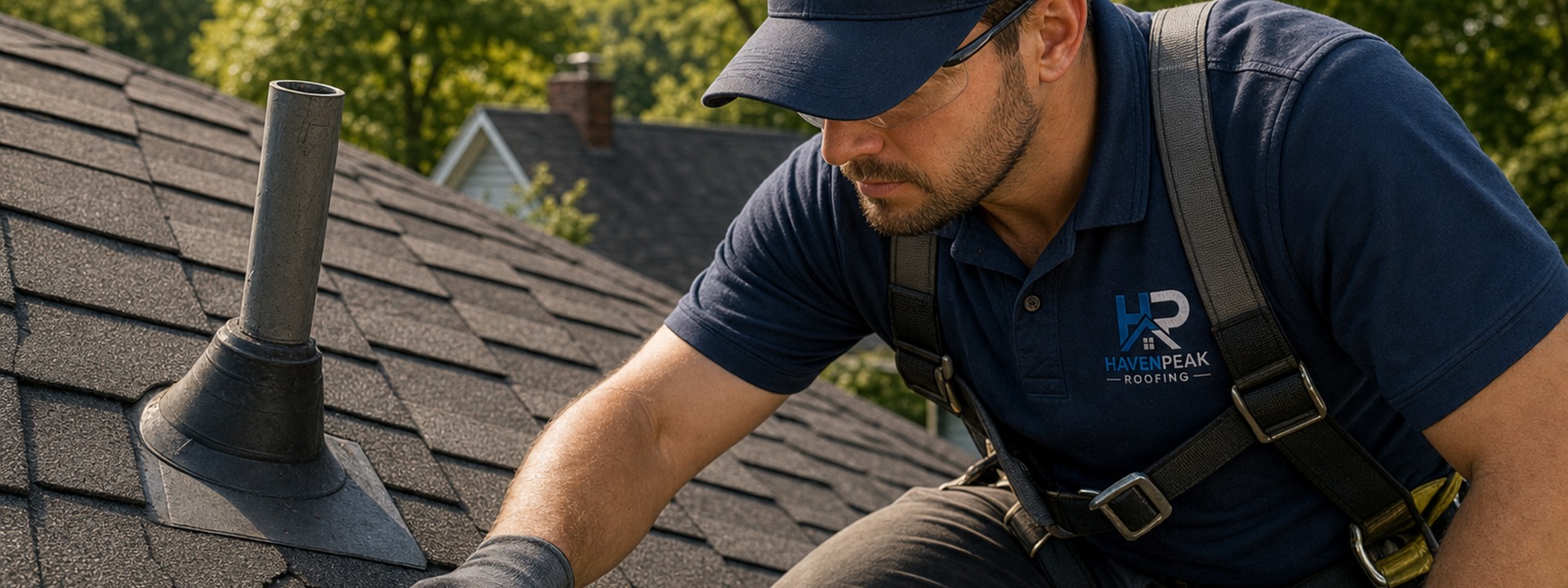
Roof Repair That Matches the Actual Failure
A stain on the ceiling rarely tells the whole story. We trace how water moves across your roof system, repair what failed, and explain what can wait—so West Hartford homeowners are not paying for work the roof does not need.
When West Hartford Homeowners Request Roof Repair
Most repair calls in Greater Hartford start with something visible from the ground: a lifted shingle after a windy night, granules collecting in a downspout, or a damp spot on a second-floor ceiling. Colonial and Cape-style homes along North Main Street and the West Hill neighborhoods often show wear at pipe boots and step flashing long before the field shingles look tired.
Ice backup at north-facing eaves is another frequent trigger. Water may travel several feet along the deck before it drips inside, which is why the interior stain is not always directly below the roof defect. We also see porch tie-ins and low-slope rear additions fail first because they handle runoff differently than the main pitched roof.
Repair makes sense when the covering still has reasonable life and the failure is isolated—one slope after a branch strike, a chimney corner that was never flashed correctly, or wind damage limited to a ridge section. Our job is to confirm that scope before any shingles come off.
Homeowners sometimes call after another contractor suggested a full replacement. A second look at flashing and ventilation often changes that picture. We document what we see so you can compare recommendations with evidence, not urgency alone.
How We Inspect Before Recommending Repair
Every repair assessment begins with your description of when the problem appeared and whether it worsens with rain, melting snow, or wind. Inside, we look for active drips, stained drywall, and attic clues such as dark decking, compressed insulation, or frost on nail shanks during cold weather.
On the roof we walk the slope when pitch and conditions allow, paying close attention to transitions—valleys, sidewalls, skylight curbs, and plumbing vents. Photos document what we find so you can see the same evidence we use to size the repair. If the deck is soft or multiple slopes show widespread granule loss, we say so plainly rather than patching over systemic wear.
For multi-story homes in Elmwood and Bishops Corner, ladder access and safety lines may limit how much of the field we cover in one visit. In those cases we combine ground binocular review with targeted up-close inspection at the most likely failure points.
After the visit you receive a summary tied to photos: what failed, what we propose, and what to monitor. That clarity helps you schedule work before the next freeze cycle rather than reacting mid-storm.
Parts of the Roof We Commonly Repair
A repair quote should name the layer that failed—not just “fix the leak.”
- Asphalt shingles or ridge caps with wind tabs broken or seal strips that never adhered
- Step and counter flashing where a wall meets the roof plane
- Pipe boot collars that cracked from UV exposure or foot traffic
- Valley metal or woven valleys clogged with debris and holding water
- Drip edge and starter course at eaves where ice has lifted materials
- Low-slope membrane sections on porches and dormers tied into pitched roofs
- Ridge vents and pipe collars disturbed by squirrels or ice dams
- Skylight curb flashing where shingles meet the unit frame
What Usually Qualifies as a Repair (Not a Full Replacement)
Localized wind damage on an otherwise sound roof is the classic repair scenario: replace the torn tabs, reseal adjacent courses, and verify neighboring shingles still seal to the deck. Flashing-only failures around chimneys and dormers often qualify when the field shingles remain thick with granules and lie flat.
Small punctures from fallen limbs, slipped tiles on hybrid roofs, and separated seam tape on a porch membrane are also repair-scale when the surrounding system is dry and well attached. We distinguish between a one-time event and slow aging across every slope.
If two or more major components are failing at once—deck rot under multiple valleys, widespread curling, or repeated leaks after prior patches—the math usually shifts toward replacement. We explain that threshold with photos so you can plan ahead instead of stacking short-term fixes.
Age alone does not disqualify repair. A twenty-five-year-old roof with one wind-damaged slope may still merit a targeted fix if underlayment tests dry at the repair zone and adjacent courses remain pliable.
What a Repair Estimate Should Include
A clear repair scope lists materials by name, quantities, and where they install on the roof. It should note whether matching shingles require sourcing from a discontinued line, which happens on older West Hartford homes with three-tab roofs from the 1990s.
Access matters in Hartford County: steep pitches, slate walks, and tight lot lines along Fern Street or Park Road can affect labor more than shingle cost. We include debris handling, magnetic nail sweep, and protection for landscaping when work occurs over planted beds or walkways.
Timeline and weather contingencies belong in writing too. Asphalt seal strips need moderate temperatures to bond; we schedule accordingly during early spring and late fall swings common in central Connecticut.
Warranty notes on matched repair shingles should appear in the scope as well—manufacturer rules on partial repairs vary, and we follow integration steps that keep manufacturer requirements in view.
When Repair Is Not the Right Call
Patching over saturated decking is only a short-term measure. If insulation is wet and mold risk is rising, covering the surface without drying the assembly can trap moisture against structural members.
Repeated leak locations after multiple repairs often signal underlayment breakdown or widespread nail fatigue. On homes with two layers of shingles already in place, building code and manufacturer rules may require tear-off rather than a third layer—another case where repair is not appropriate.
We would rather lose a small job than leave you with a roof that fails again at the first nor’easter. When replacement is the sensible path, we outline phasing options and how temporary dry-in protects interiors while you decide.
Structural concerns—sagging ridges, cracked rafters, or chimney movement—also move the conversation beyond repair. Those findings get flagged immediately even when the symptom looked minor from inside.
Roof Repair Considerations Around West Hartford
Hartford County winters test every detail: freeze-thaw cycles open tiny gaps at nail heads, while heavy wet snow loads stress older rafters on 1920s-era homes near the Center. Tree cover in Westmoor Park and the reservoir neighborhoods drops branches that scrape granules off south slopes year after year.
Many properties here mix a primary pitched roof with flat porch sections or garage tie-ins. Water often enters at those transitions, not in the open field. Local familiarity with common housing stock—from brick colonials to split-levels in the Acre—helps us know where to look first.
We coordinate with neighbors on shared driveways and HOA color guidelines when matching shingle blends on townhome rows along New Britain Avenue. Respect for property lines and quiet work hours matters in dense village districts.
Seasonal timing in Hartford County affects repair durability: fall repairs should complete before sustained freeze, while spring work addresses winter damage before summer heat sets seal strips.
Our Repair Process From First Call to Finished Work
From assessment to final sweep, each step has a defined purpose.
- Describe symptoms by phone or form; active leaks get safety guidance first
- On-site roof assessment with interior and attic review when accessible
- Written scope with photos showing failure points and proposed materials
- Scheduled repair during weather-suitable windows
- Final walkthrough and notes on what to watch through the next season
- Optional follow-up after the first heavy rain or snow melt
Unsure whether a patch will last through another Connecticut winter? Start with a roof assessment and photos you can keep.
Request a Free AssessmentRoof Repair FAQ
You May Also Need
Roof Inspection
Pre-purchase, seasonal, and post-storm roof assessments
Roof Leak Repair
Leak tracing and source repair (distinct from general repair)
Emergency Roof Repair
Urgent leak control and stabilization when water is entering
Roof Flashing & Waterproofing
Flashing, transitions, ice barrier, chimney interfaces
Skylight Repair & Replacement
Skylight leaks, curbs, and unit replacement
Roof Replacement
Full roof replacement scope, materials, and project planning
Nearby Cities We Also Serve
Roofing Contractor in Hartford, CT
dense urban housing, Victorians, triple-deckers, and downtown low-slope commercial roofs
Roofing Contractor in Bloomfield, CT
suburban colonials mixed with low-slope commercial sections near corporate campuses
Roofing Contractor in Newington, CT
suburban ranches, split-levels, and mid-century neighborhoods with standard gable roofs
Roofing Contractor in Farmington, CT
Farmington Valley colonials, village-center homes, and corporate-campus low-slope roofs
Request Roof Repair Help
Describe what you are seeing—stains, missing shingles, or recent storm damage—and your West Hartford address.